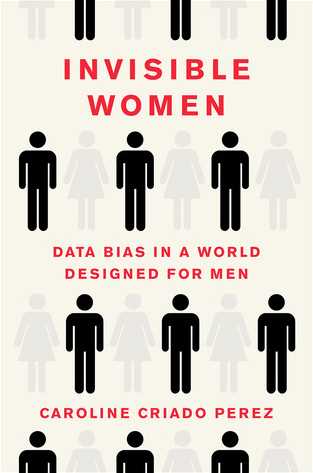
In this March edition of our Newsflash – celebrating International Women’s Day 8 March – we are proud to dedicate our EAN Book Recommendations Series to a truly inspiring read: "Invisible Women: Exposing Data Bias in a World Designed for Men" by Caroline Criado Perez.
We are also delighted to introduce two of our newest external members – please join us in giving Asma and Ellen a very warm welcome!
A heartfelt thank you to EAN member Justine for her valuable contribution to this Newsflash.
And don’t forget – previous editions of the Newsflash are now available on our website.
Did you know that women are 47% more likely to be severely injured a car crash of similar intensity, because crash-test dummies are modelled on an average male body? Or that office temperature is 5°C too cold for the average woman because the “optimal” temperature was calculated based on male metabolism? Or that sildenafil citrate (the active principle of Viagra) could help with period pain, but hasn’t been properly investigated due to a lack of data on how widespread it is, and therefore how large the market might be? Neither did I, until I read Invisible Women. Through vivid examples and detailed explanations of the mechanisms at play, British author Criado Perez shows how the data we collect (or fail to collect) shapes the world we live in. Because so much data has been based on men, the systems built from it often overlook women’s needs, sometimes with life-or-death consequences. Although this book was published in 2019, its message is even more relevant today with the growth of AI models. Indeed, such models are trained on existing datasets and inherit (or even amplify) their biases. I was recommended this book in Spetses, so it feels right to share it further through the EAN. If you want to better understand the dynamics between data and gender inequality, have a response ready next time your lab coworker says “we’ll focus on male monkeys because females are complicated with cycles and all” or just learn tons of fun facts to shine in society, this book is for you. Read it and spread the word !
Justine Schaeffer is a microbiologist and a EUPHEM alumni from C2019. She’s currently working at the Regional Health Agency of the Grand Est region in France as head of outbreak investigation and control. She’s a former EAN board member and stays involved in the EPIET fellowship.
If you want to share a book recommendation, don't hesitate to contact us by email!
Spotlight on the Network
Introducing Asma Saidouni
Dr. Asma Saidouni is a veterinary epidemiologist and One Health specialist currently serving as Technical Officer for One Health at the World Health Organization (WHO) in Libya. With over a decade of experience across Africa, the Middle East, Asia and Europe, her work focuses on infectious disease prevention, preparedness and response, with expertise in multisectoral governance, surveillance, risk assessment, early warning and capacity building. In her current role, she leads efforts to institutionalize and operationalize the One Health approach in Libya, including support to national governance mechanisms and strategic planning in complex settings. She joined EAN as an external member to connect with a strong community of field epidemiology professionals, exchange knowledge and experiences across regions, and contribute to advancing collaborative approaches to health security and epidemic preparedness.
Introducing Ellen Generaal
Hello! My name is Ellen Generaal (39 years old) and I currently work as an infectious disease epidemiologist at the Public Health Service of Amsterdam, the Netherlands. In addition, I am programme coordinator of a national consortium facilitating research on infectious diseases: the Collaborative Academic Practice for Public Health Infectious Diseases (CAPI).
I am trained as a human movement scientist and epidemiologist. After completing my PhD in psychiatric epidemiology at Amsterdam UMC on chronic pain, I worked on postdoctoral projects examining the impact of the living environment on mental health. In 2019, I moved into practice-based research at the Public Health Service, driven by a desire to work more closely with people rather than solely with data. During the COVID-period, I also gained experience with national surveillance data through part-time work at the National Institute for Public Health and the Environment (RIVM), opening my eyes to the research opportunities offered by surveillance data.
My research at the Public Health Service of Amsterdam primarily focuses on the prevention of hepatitis B and C among key populations, including people who use drugs and migrant communities. While I have led several screening projects in Amsterdam, I am eager to expand this work through European collaboration. As WHO targets remain out of reach, key populations continue to change, and funding opportunities might decline, I feel that strong international networks are more important than ever to drive prevention efforts and promote health equity.
I am excited to join EAN as an external member to strengthen my knowledge of surveillance and outbreak research – and EPIET remains on my bucket list. I frequently attend ESCAIDE, a conference that gives me a lot of energy, so I hope to see some of you there in the near future!
Be part of the community: ways to stay involved and connected!
Do what you love to do!
You'd like to get active on a project for our community? An experience you'd like to share or a topic you'd like to educate on? Please reach out to us at [email protected] if you'd like to discuss your idea and want our support. We are available to help you bringing your ideas come to life.
Support us with (small) tasks
Our community lives from all of us and the capacities of the volunteer board alone are limited. Every now and then, we may reach out to ask for your help on specific tasks or activities to get the best out of it for all of us. Of course, feel free to reach out proactively to see how you can help.
Activate your membership
Many benefits are lined up for active members of the network (GOARN requests of assistance, bulletins, discounts on mini-modules, access to specific ressources on our website...). You can activate your membership at anytime! The annual membership fee is now €40. There is a 5-year membership available at €180. Fellows in their first and second year of training are exempt from paying membership fees.
To activate or renew your membership, you can log in on the website. Open your profile and click on the button "Contribute now" and follow the steps. Alternatively, you can transfer the membership fee to the following Qonto account. Please indicate your name and membership year as reference in the bank transfer and also send an email to [email protected] with a copy of the receipt/invoice to inform us about your payment (sometimes names are not correctly transmitted with the transfer).
Account Holder: E.A.N. (EUROPEAN PROGRAMME FOR INTERVENTION EPIDEMIOLOGY TRAINING ALUMNI NETWORK)
IBAN: FR76 1695 8000 0194 6262 7758 670
BIC/Swift code: QNTOFRP1XXX
Intermediary bank's BIC/SWIFT: TRWIBEB3XXX
Bank address: 14 RUE DU VAL D'OSNE, 94415 SAINT-MAURICE CEDEX, FR
If you require any further information on membership payment, we kindly ask you to contact us by email. Thank you for your support!